
Concrete calculators
Concrete Bag Calculator
Find how many bags of concrete you need from project dimensions, cubic feet, or cubic yards. Compare 40 lb, 50 lb, 60 lb, and 80 lb bags, including bags per yard estimates. For slab-specific cost and ready-mix guidance, use the Concrete Slab Calculator.
Concrete volume
Enter project dimensions or a known volume, then choose the bag size you plan to buy.
Bag yields are approximate. Check your product label, add a small margin, and avoid mixing more concrete than you can place before it starts to set.
Estimated bags needed
Live estimate based on your inputs.
Selected 80 lb bags
Round up before ordering and confirm the exact yield on the product label.
Bag count comparison
Related
Related Calculators
Concrete Slab Calculator
Calculate concrete volume from length, width, and thickness.
Concrete Calculator
Start from the concrete calculator hub for common concrete projects.
Concrete Cost Calculator
Estimate concrete material cost from yards and local price.
Concrete Footing Calculator
Estimate volume for foundation footings and trenches.
Bagged Concrete Planning Visual
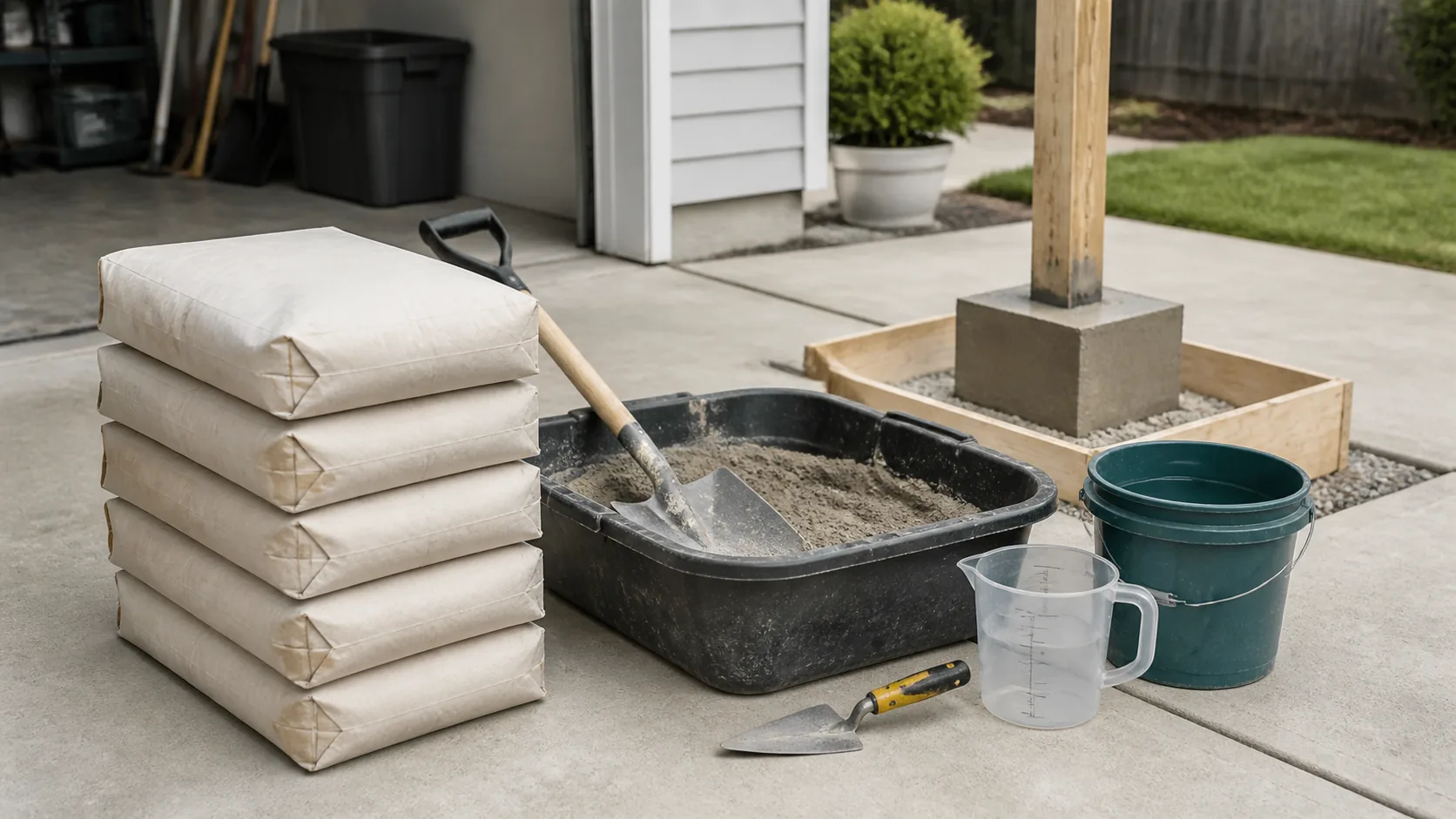
Project visual
Use bag estimates for smaller pours and comparison
Bagged concrete is practical for small pads, posts, repairs, and projects where ready-mix delivery is too much material. Compare 40 lb, 50 lb, 60 lb, and 80 lb bags, then check the exact yield on the product label.
How to Use This Concrete Bag Calculator
Enter concrete volume
Use project dimensions when you do not know the volume yet, or switch to cubic feet or cubic yards when you already have volume.
Choose a bag size
Select 40 lb, 50 lb, 60 lb, or 80 lb bags to highlight the bag count you are most likely to buy.
Compare all bag counts
Review every common bag size before ordering, then confirm the exact yield on the bag label.
Common Bag Yields
| Bag size | Approximate yield | Best for |
|---|---|---|
| 40 lb bag | 0.30 cubic feet | Small patching jobs, fence posts, and easier lifting. |
| 50 lb bag | 0.375 cubic feet | Products sold in 50 lb bags; confirm the label yield. |
| 60 lb bag | 0.45 cubic feet | General small projects where bag weight is still manageable. |
| 80 lb bag | 0.60 cubic feet | Larger pours when you want fewer total bags. |
These are common planning yields. Product labels can vary, so use the calculator as an estimate and confirm the exact yield on the bag you buy.
Concrete Bag Examples
1 cubic yard
1 cubic yard equals 27 cubic feet, or about 90 forty-pound bags, 72 fifty-pound bags, 60 sixty-pound bags, or 45 eighty-pound bags.
10 cubic feet
10 cubic feet needs about 34 forty-pound bags, 23 sixty-pound bags, or 17 eighty-pound bags.
Small repairs
For steps, posts, and patch work, bagged concrete is often easier to plan than ready-mix delivery.
How Many Bags of Concrete Are in a Yard?
Bags per cubic yard
One cubic yard equals 27 cubic feet. Using common concrete bag yields, that works out to about 90 forty-pound bags, 72 fifty-pound bags, 60 sixty-pound bags, or 45 eighty-pound bags per cubic yard.
Bags needed = cubic feet / bag yield
| Bag size | Bags per cubic yard | Note |
|---|---|---|
| 40 lb bags | 90 bags | Best when lighter bags are easier to carry and mix. |
| 50 lb bags | 72 bags | Use when your product label lists a 0.375 cubic foot yield. |
| 60 lb bags | 60 bags | A common middle option for small concrete projects. |
| 80 lb bags | 45 bags | Fewer bags, but each bag is heavier to move and mix. |
When to Use Bagged Concrete
Good fit for smaller projects
Bagged concrete is practical for posts, steps, small pads, patching, and projects where ready-mix delivery would be too much material or too expensive.
Use slab dimensions when needed
If you do not know the volume yet, calculate length, width, thickness, and waste with the Concrete Slab Calculator, then use this page to compare bag sizes.
Concrete Bag Calculator FAQ
How many bags of concrete do I need?
Enter your concrete volume and choose cubic feet or cubic yards. The calculator divides that volume by common 40 lb, 60 lb, and 80 lb bag yields, then rounds up.
How many bags of concrete are in a yard?
One cubic yard is 27 cubic feet. That is about 90 forty-pound bags, 72 fifty-pound bags, 60 sixty-pound bags, or 45 eighty-pound bags of concrete.
How many 50 lb bags of concrete are in a cubic yard?
A 50 lb bag often yields about 0.375 cubic feet. At that planning yield, one cubic yard needs about 72 fifty-pound bags.
How many 80 lb bags of concrete are in a cubic yard?
An 80 lb bag commonly yields about 0.60 cubic feet. Since one cubic yard is 27 cubic feet, one cubic yard needs about 45 eighty-pound bags.
How many 60 lb bags of concrete are in a cubic yard?
A 60 lb bag commonly yields about 0.45 cubic feet, so one cubic yard needs about 60 sixty-pound bags.
How many 40 lb bags of concrete are in a cubic yard?
A 40 lb bag commonly yields about 0.30 cubic feet, so one cubic yard needs about 90 forty-pound bags.
How do I calculate bags of concrete?
Convert the project volume to cubic feet, divide by the bag yield, and round up. Common planning yields are 0.30 cubic feet for 40 lb bags, 0.45 for 60 lb bags, and 0.60 for 80 lb bags.
What is the coverage of an 80 lb bag of concrete?
An 80 lb bag commonly yields about 0.60 cubic feet. Coverage by area depends on thickness, so the same bag covers more square feet at 2 inches than at 4 inches.
Should I add extra bags for waste?
Yes. Bag counts are rounded up, but it is still practical to add one or more extra bags for small projects or a 5-10% margin for larger pours.
Are concrete bag yields exact?
No. Bag yields are approximate and can vary by product, mix type, and water content. Always check the yield printed on the bag before buying.
Can I use this for slab dimensions?
Yes. Use the dimension mode when you want to enter length, width, and thickness directly. Use volume mode when you already know cubic feet or cubic yards.