
Concrete calculators
Concrete Slab Calculator
Estimate concrete volume, bags, waste, and material cost for slabs, patios, sidewalks, garage floors, and other flatwork.
Slab dimensions
Enter the size of your slab and adjust waste or price.
Most slab projects use 5-10% extra concrete for waste and uneven subgrade.
Use your local supplier price for a more accurate estimate.
Estimated concrete needed
Live estimate based on your inputs.
Recommended order
Includes 10% waste. Use this as the ready-mix ordering baseline.
Bag estimate
Related
Related Calculators
Concrete Calculator
Estimate volume, bags, waste, and cost for common concrete projects.
Concrete Bag Calculator
Estimate 40 lb, 50 lb, 60 lb, and 80 lb bags for your project.
Concrete Cost Calculator
Estimate cost from yards, waste, delivery, and labor.
Concrete Driveway Calculator
Estimate concrete for driveway projects.
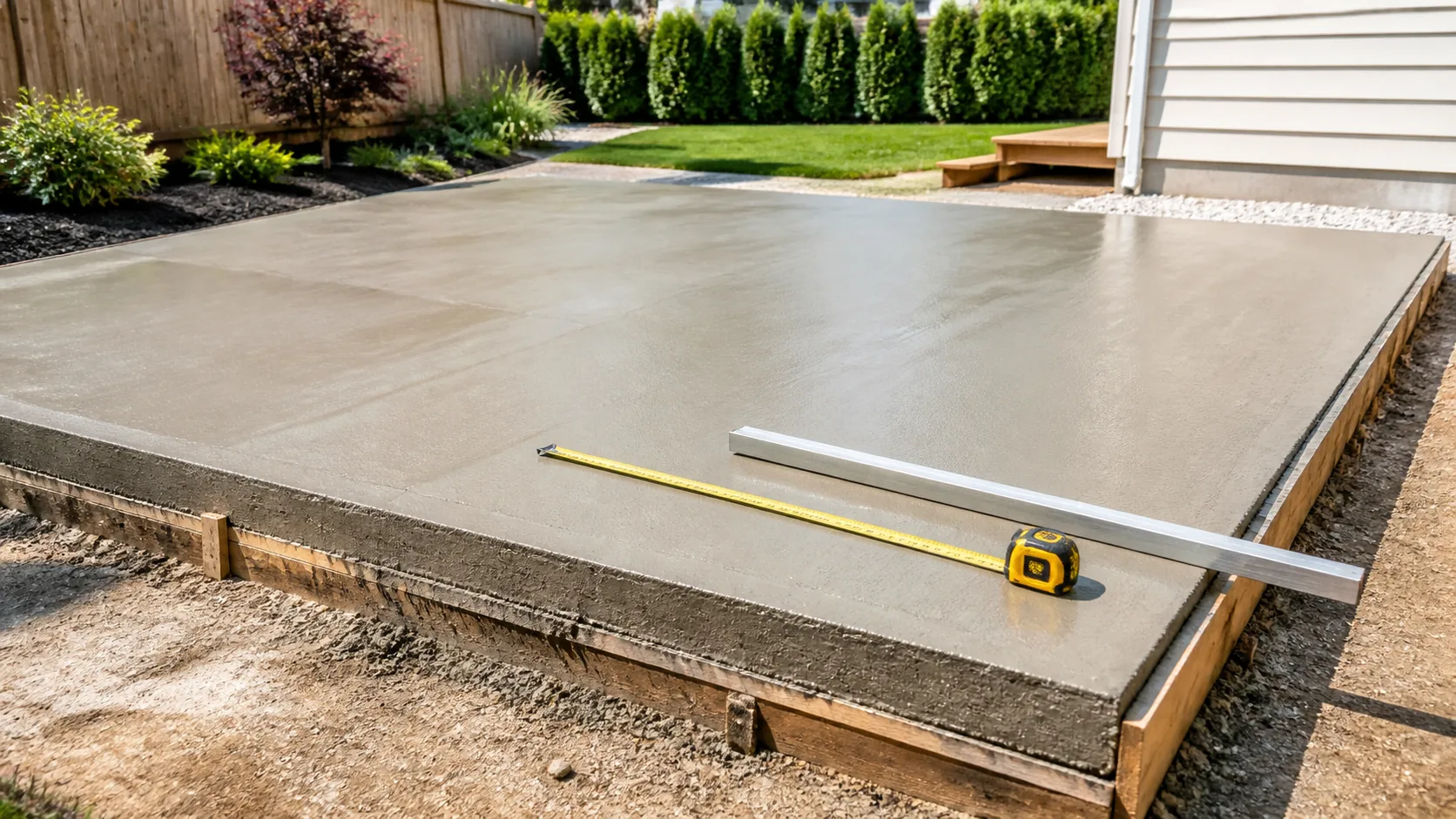
Concrete Slab Planning Visual
Project visual
Measure the slab footprint before estimating concrete
A slab estimate starts with length, width, and thickness. Use the calculator for the volume math, then confirm site conditions, subgrade, forms, reinforcement, and local code requirements before ordering.
How to Calculate Concrete for a Slab
Use the slab formula: concrete volume equals length times width times thickness. For US measurements, convert thickness from inches to feet before multiplying.
Cubic yards = cubic feet / 27
Thickness in feet = thickness in inches / 12
Example: 10x10 slab at 4 inches
10 x 10 x 0.333 = 33.3 cubic feet. 33.3 / 27 = 1.23 cubic yards. With 10% waste, order about 1.36 cubic yards.
How to Use This Calculator
Enter slab size
Add the length, width, and thickness for the slab. Use feet and inches for US projects or switch to meters and centimeters.
Set waste and price
Choose a waste factor and adjust the concrete price per cubic yard if you have a local supplier quote.
Review your estimate
Compare base volume, recommended order amount, bag counts, and material-only cost before ordering.
Slab Dimension Visual Guide
What each dimension means
Length and width describe the top surface of the slab. Thickness describes slab depth. The calculator converts thickness into feet or meters before calculating volume.
This visual guide is intentionally simple. Reinforcement, subgrade, slope, and local code requirements are separate planning decisions.
Use This Slab Calculator For
Patios
Plan concrete for backyard patios, outdoor seating areas, and small flatwork.
Sidewalks
Estimate narrow slabs and walkways using length, width, and slab thickness.
Garage floors
Start with volume and cost estimates before checking reinforcement and code needs.
Shed pads
Estimate concrete for small pads, utility slabs, and compact outdoor projects.
Common Concrete Slab Sizes
| Slab size | Thickness | Cubic yards with 10% waste |
|---|---|---|
| 10x10 | 4 in | 1.36 yd³ |
| 12x12 | 4 in | 1.96 yd³ |
| 20x20 | 4 in | 5.43 yd³ |
| 24x24 | 4 in | 7.82 yd³ |
| 20x20 | 6 in | 8.15 yd³ |
Common Concrete Slab Thickness
| Project | Typical thickness | Note |
|---|---|---|
| Patio or walkway | 4 inches | Common for light foot traffic and flatwork. |
| Garage floor | 4-6 inches | Depends on vehicle load, reinforcement, and local requirements. |
| Shed pad | 4 inches | Often enough for small sheds when the base is prepared correctly. |
| Driveway | 4-6 inches | Use a driveway-specific estimate for larger vehicle areas. |
Concrete Bags and Material Cost
Bag estimate
The calculator estimates 40 lb, 50 lb, 60 lb, and 80 lb bags using common approximate yields. For bag-focused planning, use the Concrete Bag Calculator.
Material cost estimate
The cost estimate uses recommended cubic yards times your price per cubic yard. It is material-only and excludes delivery, labor, taxes, and local fees.
| Bag size | Approximate yield | Best for |
|---|---|---|
| 40 lb bag | 0.30 cubic feet | Small repairs and very small pours. |
| 50 lb bag | 0.375 cubic feet | Products sold in 50 lb bags; check the label before buying. |
| 60 lb bag | 0.45 cubic feet | DIY projects where bags are easier to move. |
| 80 lb bag | 0.60 cubic feet | Small slabs, pads, and repairs when ready-mix is not practical. |
Concrete Slab Calculator FAQ
How do I calculate concrete for a slab?
Multiply length by width by thickness to get volume. If your slab thickness is in inches, divide it by 12 first so all dimensions are in feet, then divide cubic feet by 27 to get cubic yards.
How many cubic yards of concrete do I need for a slab?
The required cubic yards depend on slab length, width, and thickness. A 10 ft by 10 ft slab at 4 inches thick needs about 1.23 cubic yards before waste.
How much concrete do I need for a 10x10 slab?
A 10x10 slab at 4 inches thick needs about 1.23 cubic yards before waste. With 10% waste, order about 1.36 cubic yards.
How much concrete do I need for a 12x12 or 20x20 slab?
At 4 inches thick with 10% waste, a 12x12 slab needs about 1.96 cubic yards and a 20x20 slab needs about 5.43 cubic yards.
How much concrete do I need for a 4 inch slab?
Multiply length by width by 0.333 feet, then divide by 27 to get cubic yards. Add 5-10% waste before ordering.
How much concrete do I need for a 6 inch slab?
Use 0.5 feet for thickness when calculating a 6 inch slab. A 20x20 slab at 6 inches thick needs about 7.41 cubic yards before waste, or about 8.15 cubic yards with 10% waste.
How thick should a concrete slab be?
Many patios, sidewalks, and light-use slabs are around 4 inches thick. Garage floors, driveways, and structural slabs may need more thickness, reinforcement, or local code guidance.
Should I add extra concrete for waste?
Yes. Most slab projects use 5-10% extra concrete to cover waste, uneven subgrade, and small measurement differences.
How many 80 lb bags of concrete do I need for a slab?
An 80 lb bag yields about 0.60 cubic feet. Divide your waste-adjusted cubic feet by 0.60 and round up to estimate the number of 80 lb bags.
How much does a concrete slab cost?
Material cost equals recommended cubic yards multiplied by price per cubic yard. This calculator estimates material only and does not include delivery, labor, taxes, or local fees.
When should I use ready-mix instead of concrete bags?
Bag counts are useful for comparison, but larger slabs can require dozens or hundreds of bags. Ready-mix delivery is often more practical when the 80 lb bag count becomes high.